Tuesday, 13 January 2015

Week 12 [12.01 – 18.01] Psychological life hacks

Social life is among the most important things in our lives. Yet, there are so many unwritten, sometimes even unspoken rules that shape our behavior. But the worst thing that can happen is irreversible damage as an aftershock of failing to comply or blindly going forward. 
Below are set of rules (no particular order) that can help you achieve what you want, when you want.

Rule No 1 - If you want positive feedback, nod while talking
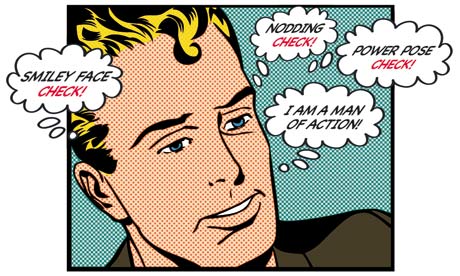

This is one of the most powerful, yet unutilized life hacks. It is a bit manipulative, so use it at your own discretion and responsibility.
Getting positive feedback is something everyone wants as a result of a conversation. It doesn’t matter if we want to promote a viewpoint, increase our salary or make a sale, nodding while delivering a message can go a long way. It makes the other person mimic what you do and nod along with you while you talk. This reaction will start a positive feeling and give their brain a “hidden” message to agree with what you’re saying.

Rule No 2 – Be comfortable in any situation


Our brains are very complicated and secretive organs. We can even say that the relationship we have with our brain is more of a hate or love one. Although there are many unconscious “suggestions” from our brains, we fail to understand most of them.
In most social situations, like meeting a new person, talking to your manager etc. our brain tries to put us in a protective shell. It does not help us much. Giving our brain command to feel like you already know the person you’re talking to puts you at an advantage. It even increases chances of people showing interest in what you’re talking about and/or even liking you.

Rule No 3 – Pay attention to the way people set their feet


As You would imagine, interrupting someone while they’re in the middle of a very important conversation can be annoying. It shows Your lack of social skills as well as no social dynamics knowledge.
How can You differentiate whether or not You are welcomed to join the conversation? Pay attention to their feet and bodies. When You approach a group of talking people, if they turn only their bodies not feet, you are not welcomed

Rule No 4 – Start Your favors with “I need Your help”

It is obvious that we like to get others to do things for us. No one likes rude people, but when you start a sentence with “I need your help”, in most cases at least, people will accept you request. This happens because people don’t feel comfortable for not helping out. They will feel guilty. People like to help. In most cases…

Rule No 5 – Trouble remembering people’s names? Repeat repeat repeat


Personally, I’m terrible at remembering names. Most of the time my brain shuts down when people say their name. A lot of buddies, dudes, bros, friends etc.
What can You do in such a situation? Ask our friend to introduce himself or herself to the group? Awkward.  Remembering names is very important as we feel more important when someone mentions our name. What you can do is start repeating their name in a conversation. Example: “Hi, my name is Kasia -> Nice to meet You Kasia -> So, Kasia, how do you know XXXXX?” and then try to repeat their name throughout the conversation.

Rule No 6 – Want someone to answer your question fully? Silence is key


Silence is a weapon. If someone finishes his/her answer without providing full feedback just wait, stay silent and keep an eye contact. The tension will grow and the pressure on the other person will grow as well. If it goes for far to long, raise your eyebrows. It puts even bigger pressure on them, but it shows that you are still interested in the answer. On the other hand, it also shows that you are a person that usually gets what you want.

There You have it. Some of the psychological life hacks that will help you in getting an advantage in social interactions. And as someone said sometime – “Use your knowledge wisely”
Questions?
      1)      What are your life hacks?
      2)      What is your favorite color?
      3)      What do you think about dying rain forests?
      4)      Were you aware of such social interaction tweaks?
      5)      Knowing them, will you use them for Your advantage?

Soruces:
1) http://static.guim.co.uk/sys-images/Observer/Pix/pictures/2012/6/29/1340992572775/self-help-graphic-007.jpg
2) http://31.media.tumblr.com/tumblr_m0k7xz3dr31qarksao1_500.jpg
3) http://upload.wikimedia.org/wikipedia/commons/a/a4/Ballet_Feet_Fifth_Position.JPG
4) http://evelinruns.com/wp-content/uploads/2014/02/Will-You-Help-Me.jpg
5) http://ucandostuff.ph/FrameWork/Upload/StepImage_c634290a-776e-46dc-98cc-2459fcb04674_big.jpg
6) http://www.nonprofithub.org/wp-content/uploads/2012/02/asking-for-donations-silence.jpg
7) http://www.highexistence.com/25-psychological-life-hacks-help-gain-advantage-social-situations/

Monday, 12 January 2015

Week 12 [12.01 – 18.01] Saving money

     Everyone wants to have money, a lot of money. However, not everyone has it. People think that if our salary is higher our life will be happier. That’s not true. Often it’s not a low salary but bad financial management makes us poor. Many people don’t think about what they buying and sale time and discounts are times when the brain turns off. Finally they buy products they don’t need, at a price which sometimes is higher than before the discount. Afterwards we have no money for things we want and we have a heap of trash.
     The first step to save money is to see where our incomes disappear. With that problem will help us some applications:

1. Microsoft Excel ( I think everyone knows it, but I guess only few people are able to take its full capabilities )
2. Microsoft Money Plus Sunset Deluxe ( Long name, but in short it’s a electronic wallet. We can archive our incomes and expenses )

On the Internet you can find many more similar applications but these two are one of the most popular ones.
     Afterwards when we see a money leak, we have a possibility to limit this situation. The first step is sufficient for the most people. For others who can save and earn more a bank deposit can help. We can get there some extra money Simple, safe and profitable. If you have more courage you can play the stock market. It’s a harder way and you need a lot of knowledge about how stock market works. However, if you take the risk, you can gain a lot because stock markets offer the biggest risk and the biggest income.


     In reference to the first paragraph,  I’m not saying that discounts and sales are bad and dangerous. It’s a good way to buy something cheaper but we should use them using brains.

Questions:
1. Do you try to save money or rather you are a wasteful type?
2. What other ways of saving money do you know?
Source:
1. http://www.moneymanagement.org/Financial-Education/Loan-Management.aspx


Week 12 [12.01 – 18.01] Ecology?

     Humanity has always used  natural resources for their own goals. However , until the industrial revolution it didn’t cause big problems.
Humans who have existed for only 200 000 years have changed  the earth and introduced confusion into the natural environment; rainforest cutting, air pollution, hunting and many more humans ‘ behaviors cut the chain which kept order between all species. It’s a huge problem not only for fauna and flora but mainly for humanity.


     The picture above presents a documentary movie called “HOME”. It shows how beautiful our planet is and what we can lose if we don’t change our approach to using natural resources.
      We should promote various synthetic counterparts for things which are made from nonrenewable natural resources. A good example is e-paper. E-book readers are gaining popularity very fast and I guess within several years it can totally replace plain paper . However, it will probably look different than today. This change should save a lot of trees which can clean the air. We should promote various types of renewable energy instead of coal and petroleum. Natural resources will come to an end soon but then it will be too late for finding a new source of energy to power all electric devices.
There are people and organizations like Greenpeace,  ecologists who fight to change law in order to protect the natural environment. These organizations do  not always achieve their goals but with help of society they often have influence on  governments and business.
      The biggest organization called Greanpeace was established in 1971 in Vancouver and have offices in many countries. They have very wide area of actions. They work for stopping climate changes,  protection of  rainforests or stopping genetic modifications. Many people say that Greenpeace is too radical because some actions are near to eco-terrorism. They are criticized  for taking part in the discussions of ecology, when their ideas are neither ecologically nor economically appropriate. Greenpeace cofounder Patrick Moore left the organization  as he believes that the organization is motivated by money and politicians  and forgot about the main targets.
There are many other areas where changes are needed. Perhaps these changes will depend on our generation.

Questions:
1. How can we reduce human impact on natural environment?
2. What do you think about Greenpeace? Are similar organizations needed?

Sources:

1. http://www.treehugger.com/culture/world-premiere-of-yann-arthus-bertrands-home-this-environment-day-june-5.html

Saturday, 10 January 2015

Week 12 [12.01 – 18.01] Planned Obsolescence


Planned obsolescence is the strategy followed by companies that are designing and manufacturing different products. It's goal is to make consumers replace every product with the one that is newer before the last one breaks or it's functionality becomes outdated. If it breaks, it is not in the producer's interest that a consumer has a possibility to have it repaired cheaply by an independent technician or (God forbid !) by the consumer himself !


Nowadays, the design experts' task is to make sure that the merchandise is bound to break as soon as the warranty period expires.
If the product is too simple to break on demand there are other tools to make it unwanted by the customer. The great example would be fashion that is changed by "independent" fashion creators every year.


Of course the producers never admit to follow the planned obsolescence strategy and mostly deny it openly.

Quote from The Economist:
" A classic case of planned obsolescence was the nylon stocking. The inevitable “laddering” of stockings made consumers buy new ones and for years discouraged manufacturers from looking for a fiber that did not ladder. The garment industry in any case is not inclined to such innovation. "

This graphic looks funny but look carefully at it, think about different models of mobile phones, cameras, computers or cars that we have recently used: doesn't it look familiar ?


Probably the most notable and "classic" example of the concept in question is the story behind light bulbs production industry.

In 1924 companies including OSRAM, Philips, and GE decided to handicap the technology of light bulbs, because…they lasted too long. The Phoebus Consortium was formed to control the market: from production to distribution and sales. The decision was made that the bulb cannot last longer than 1000 hours (instead of 2000 hours which was the regular time for state-of-the-art bulbs at the time).

Planned obsolescence has a colossal impact on ecology.  In 2013 the Green Party of Germany conducted research that revealed that the "planned aging" of household electronic equipment cost a couple of billions of  Euros every year just in Germany.


Questions:
·      Have you ever come across the term "planned obsolescence" before reading this article ?
·      What is your opinion on the subject: do you see it as a real problem or maybe you think it is just an anti-industrial conspiracy theory ?
·      Do you know any interesting examples of planned obsolescence concerning the devices that you use every day ?
·      would companies benefit more from designing durable devices and products?


Sources:
·      Sources of photos: quiet-environmentalist.com, www.allhailtheblackmarket.com

Week 12 [12.01 – 18.01] Faulty products – the case of Apple


One might think that in the industrial world of 21st century, where design is performed digitally and every single machine on every production line in the world is controlled by computers, there is no more room for faults in new products. Yet every year we hear about a couple of cases of spectacular failures of big companies when introducing new products.


Probably the most notable example in the last few years is Apple. Of course there are many other companies that failed at some point in the area of consumer electronics or other segments of the market, but I decided to take Apple as an example for two reasons.

The first one is their absolute perfection when it comes to quality. These products are also recognizable around the world so whenever there is news that points out an important glitch, it usually gets enormous attention.

Steve Jobs always emphasized this aspect of the product and took it as a personal goal to make quality the trademark of Apple products.


The second reason is how this company tackles problems.


Who of you haven't heard the term "Bendgate" coined by the internet community in response to the obviously faulty Apple's new smartphone iPhone 6 Plus ?

The new iPhone 6 featuring two versions: the regular and the one with a bigger display "Plus" was introduced in the fall of 2014.
Quite quickly the rumors circled the internet, stating that the bigger version of the phone has a nasty habit of getting bent.

Many Internet users started posting photos and videos of the damaged phone.


The author of "Unbox Therapy" Youtube channel decided to test the possibility of damaging the phone. The video received a lot of attention – more than 62 millions views.


As the saying goes "your loss is my gain", the competitors quickly took advantage of  the situation and advertised their own product.
I remember quite a funny one from Samsung:


Interesting is the approach that the company took when confronted with such a critical situation.
At first, the Cupertino company tried to play the issue down. Official statements were made, saying that after a few weeks only 9 customers worldwide contacted the company and informed about the problem.
Finally, under the massive criticism they decided to agree on replacing faulty devices if the phone passes the "visual inspection" performed by apple sales representative (in the case of USA and other countries where Apple has its own retail network)
Unfortunately, the author has no information on how the company decided to solve the issue in Poland and other countries where the retail of Apple's products is operated by resellers.

Regardless of those major issues mentioned in the above text, many minor defects can be found in products of every single brand in the consumer electronics market.

The author had a chance to speak "off the record" with a mobile phone retail expert. This man revealed that regardless of the brand of the phone, nowadays companies usually accept minor production/quality defects of their devices as long as the demand is really high, especially in the time following the introduction of a new product. When the demand decreases, the quality control tightens and only the shipments with the proper quality are allowed to leave the factories.


I can recommend you quite an interesting businessweek.com article about the process of resolving quality issues by Apple company. The link is placed in "Sources section".

Questions:

·      Have you used new iPhones affected by the problems described in the article ?
·      Did you have any serious problems witch electronic devices you purchased in the past – how was the problem resolved by the producer/retailer ?
·      What is your opinion on the approach companies and retail networks in Poland present in the case of customer complaints – did you have similar or different experiences abroad ?


Sources:

·      Sources of photos: www.investopedia.com, www.theydontloveyou.com, www.yahoo.com, designwebkit.com

Monday, 15 December 2014

Week 11 [15.12 - 21.12] Fan conventions


Fan conventions


You've probably heard about these, like the world famous Comic-Con or if you're more into Japanese popular culture – Anime Expo or Japan Expo. Maybe you've been at one. Conventions are events that gather people who share similar interest, be it fantasy genre, comic books, manga and anime (or Japanese culture in general) or television series and movies. The most popular conventions in our country center around the first three subjects and these are the ones I'd like to talk about.


Usually they're organized annually, often around the same date and in the same location, but there are exceptions. The oldest and one of most popular Polish fantasy conventions, Polcon, takes place in a different city every year. Conventions last two or three days (which usually corresponds with weekends), sometimes only one day and sometimes they're longer. Fans, both local and from around the whole country often come earlier, before the opening, to save a place in a queue that can later grow into a huge size. After some time, they get inside the building called a conplace. A conplace may be a school building, a hotel, a stadium, a cultural center or a specifically built for this purpose, convention/ conference center.


A queue in front of Atlas Arena, Międzynarodowy Festiwal Komiksu in Łódź, 2014


While at a convention you may participate in a wide array of activities. Firstly, there are lectures (given both by amateurs and professionals alike) on various topics. Of course the subject of these lectures depends on the theme of the convention, but a lot of them will present a specific comic book or anime series, certain trope from culture and history. You can discuss works of a certain author or simply, meet him/her and talk about their work experience, ask them questions personally. You can also take part in contests and win prizes ranging from books, gadgets to the convention’s currency (e.g. pyrfunty at Pyrkon) which you can later exchange for something you like. Besides, frequently there are game rooms - sections where you can sit down in front of a computer or a console and test a game out, or simply have fun with friends.

If you're at anime or fantasy convention, you'll sooner or later meet a person wearing a costume. That person, a cosplayer, impersonates a character from a popular culture (a TV series, a video game, a comic book etc.). There are special contests organized for such people in which the best cosplay is chosen.


Cosplayers, notice the scene is in a school gym, Animatsuri 2013


At every convention there is also a section dedicated to shop stands where you may buy stuff you probably won't find anywhere else and maybe even get a bargain. Among these shops you can spot artists and craftsmen who sell their artbooks, art prints or hand-made jewelry. Some of them will give out autographs, though at larger events the process of signing autographs can be organized, like at MFK in Łódź where you need a ticket with a number, otherwise you may be asked to leave the queue (it depends on an author's decision).

Fan convetions are also a great opportunity for companies and publishers to promote their products. For example, while at Międzynarodowy Festiwal Komiksu in Łódź, I had a chance to play around with Wacom Cintiq tablet (something I missed at Pyrkon earlier).


 Artists' stands, also a school gym


Shop stands at Pyrkon 2013, Poznań International Fair


Last but not least, you can meet people who have the same interests as you! Fan conventions are full of interesting, sometimes strange or even outright crazy people. While I'm aware there are always some downsides of such events, I still think it's worth taking part.


Questions:
Have you ever been at a convention? If yes, what kind of? Did you like it?
What do you think of this kind of events?


Sources:


Week 11 [15.12 - 21.12] Sound art

Sound art


Sound art is a very intriguing contemporary art discipline that takes many forms, both small and monumental. It deals with many subjects including experimenting with the sound itself, but also with objects and materials that can generate it or finding sound in places that you wouldn't normally associate with it. I chose a few examples of sound art projects which in my opinion are interesting. Of course I encourage you to watch the videos.


Playa
Made by Ruben Dhers, it's an installation made up from 14 acoustic guitars and 31 dc motors that... play these guitars. You might think that this can't sound good, but it's actually quite pleasant to listen. See for yourself.


The Singing, Ringing Tree
A sculpture designed by Mike Tonkin and Anna Liu which can be found in Lancashire, England. It is made of steel pipes that generate sound thanks to the wind blowing through them. While eerie or even unpleasant at times, it's definitely interesting.


Everything Was Forever, Until It Was No More
By Konrad Smoleński. An installation you might have seen as it was available to view in Zachęta not long ago. It consists of two bronze bells, loudspeakers and resonating objects. The main idea behind this installation is to manipulate the bells' sound by slowing it down and adding reverb which turns it into a tangible mass that shakes the environment. I saw the installation itself, but unfortunately I haven't seen any of the performances.


Mirrors
Created by Tim Bruniges, an artist based in Sydney, it is an installation composed of two large concrete slabs facing each other. Their positioning and characteristic shape makes them „sound mirrors”, hence the title of the project. The microphones hidden in the center of each mirror pick up ambient sounds in the environment around, then the sound is amplified and reflected between both mirrors creating delayed acoustic patterns.


SPINE
Spine is a huge, fifty meter long installation created by Kollision from Denmark. It's made of twenty glowing cubes hanging in an almost empty hall combined with ambient music and sounds. What's important the sounds and movements of the whole installation are generated in real-time as a reaction to people who pass by.


Every Object Has a Spirit
Oliver Jennings plays around with everyday objects while using contact microphones to capture the resonances in them. This creates strange, ambient-like patterns and soundscapes. He also uses a device that measures the bio-activity of plants and, based on this, creates MIDI-notes which can be then used to turn into music.


Questions:
What's your opinion about this art discipline?
What do you think about the examples I've posted?
Have you seen any installations that could fall into the category of sound art?

Sources: