Monday, 8 April 2013

Week 4: My trip to Peru


A year and a half ago I and a few of my friends  visited Peru for 3 weeks. Equipped with backpacks and both way tickets we left Warsaw in the middle of September 2011. But everything started a few months earlier when one of us during a meeting threw an idea about visiting Peru. Immediately we started to look for cheap flight tickets from Warsaw to Lima, the capital of Peru. Unfortunately there were no direct cheap flights, so we needed to find a combined one. After a week or two we bought very cheap tickets from Warsaw, via Dusseldorf, Frankfurt to final destination in South America, Bogota –the  capital of Columbia. From Bogota we had the next day a flight to Leticia, a small village located at the point where Columbia, Peru and Brazil come together in an area called Tres Fronteras.


We had been preparing for this trip for about 3 months, making different versions of plans with places we wanted to visit. So it started in Bogota, Columbia, which for me is the best known from narcotics, especially cocaine and the kidnapping of white people for money. And actually it is true – Columbia has one of the highest rates of kidnappings in the world. Knowing that, we were quite frightened about spending 1 night there before reaching our final destination. After all it wasn’t so bad for us.
But the main adventure started in Leticia a village situated at the Amazon River. We stayed there for a few days before going further into the country. Most clearly from this place I remember a trip to the Amazon jungle which was guided by a local guy.


I was totally amazed how the Amazon jungle looks like and what kind of animals live there. Quite obvious for me was to expect snakes or parrots but it was really nice and unexpected to meet a toucan.


Just after enjoyable stay in Leticia – a city without road access from outside – we moved to Iquitos, which is the largest city in the Peruvian rainforest. We were quite surprised by meeting a lot of white people (gringos) there. Quite soon we found out that Iquitos has the largest gringo enclave in Peru. We stayed there for a few days making small trips, from which I remember most a meeting with sloth and its baby.


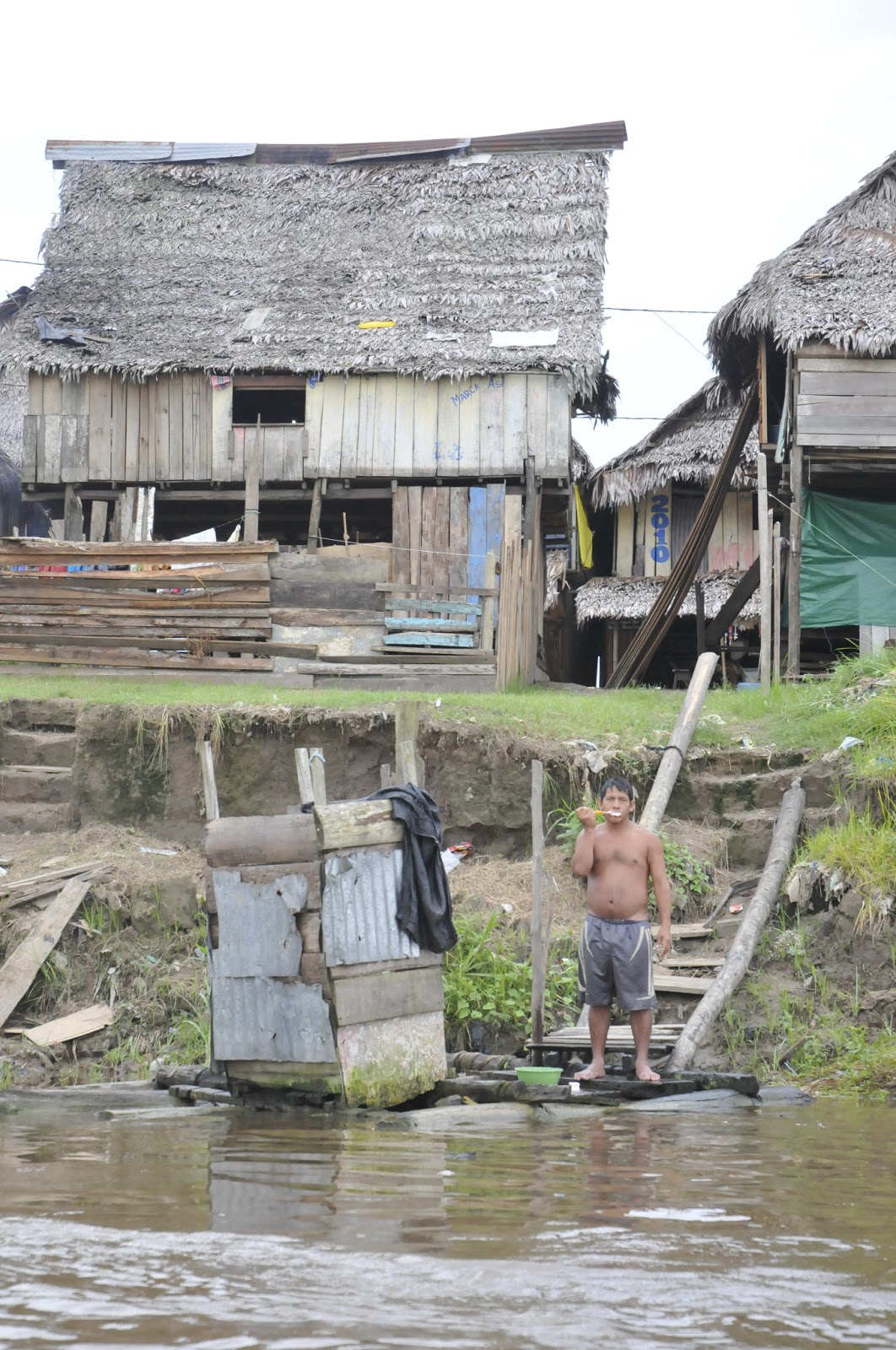
While we were following the Amazon River we saw also non touristic, very poor places like the one presented in the photo below:


Next on our list was Lima, where we rented a car and started visiting the country using our new way of transport. Quite fascinating was the island named Ballestas, with many caves and arches which provide shelter for tens of thousands of seabirds and sea-lions. It's really interesting how Peruvians two centuries ago used "guano" (birds droppings) produced by seabirds - they exported the product to Europe for use as a fertilizer.


Particularly I was very keen on visiting Nazca lines. We bought tickets to fly over lines, in a small plane. It was an amazing experience.


Later we visited more places, but worth mentioning was for sure the Lake Titicaca, located above 3800 meters above the sea level. Being just a few days on that kind of height gave us huge headaches and problems with breathing.

 Of course we wanted to see the very best known place in Peru - Machu Picchu. Unfortunately our rented car failed to go there, however we managed to visit a few other ancient cities with breathtaking stone architecture.

Questions:
1. Do you like far away journeys ? Which is your favourite country/region?
2. Have you ever been to Peru or would you like to visit this country ? What do you know about Peru?
3. Are you afraid to travel abroad on your own ?

Wednesday, 27 March 2013

Week 3: Be REady for REuse!


We live in a consumer society, in which having determines our existence. We want to have more and more. Omnipresent advertising defines the concept of happiness and drives our desires so we buy. We buy tons of things which we do not really need. This means that we also throw away a lot of them. We throw away clothes that seem to us to be no longer fashionable. We discard electronic equipment that is no longer the latest model. We get rid of the things, because they have bored us. We replace them with new ones, but the old ones are still perfectly usable.

This is no longer the times, when buying expensive equipment has been an investment for  years to come. Buy, have, throw away (or take it to the attic), buy new ones. That’s how it works. Fortunately, many people are aware of this horrible waste. Some people just want to buy and have more, but at a lower price. Here comes the idea of reusing stuff!

You don’t need something anymore. Is it still usable? Instead of throwing it away just sell it! You’ll get rid of unnecessary things, get back a little money, and a happy buyer will get a fully useful item for a much lower price. Your trash will be a little less filled, and your eco-conscience a little cleaner. There are only winners in this game.

What can you buy from second hand? Everything I suppose. Even if you’re not really into second-hand stuff, buying used car is not anything extraordinary. The same is with electronics. Some people love buying second-hand clothes – they even treat tense search among thousands of hangers as a life passion. It is especially popular in Eastern Europe. In Warsaw we have second-hand shops even on the main streets of the city . There are also boutiques with luxury used clothes, which are still very expensive, but affordable for determined fashion fans. 


I allow myself a moment of sincerity – I love the idea of reusing things. My largest discovery in the second-hand world is used furniture. Antiques are another story, but if you thought that in order to cheaply furnish your apartment you have to buy the cheapest (and less durable) furniture from IKEA, you were very wrong. For the same price (or sometimes lower), with a little research and patience, you can have a beautiful, nonstandard furniture made of wood, which will serve you for a long time.

Where to buy all these wonderful used things? On the markets, in special stores, consignment stores. On the Internet- in online auctions, thematic portals, web pages with announcements. In Poland there is no such practice, but in some countries people organize garage (or yard) sales.


Summing up – buy, have, sell, buy a new second hand one!


Questions:

- Do you buy used things? What kind of things are they ?
- Do you sell your used stuff? Is it a hard thing to do?
- Do you think that second-hand market will continue to grow, or is it just a temporary trend for enthusiasts?


Interesting links:


Tuesday, 26 March 2013

Week 3: Photoshop - modern censorship ?


Recently I have found on the Internet interesting news from July 2012. A 14-year-old girl,
Julia Bluhm, has started the online petition against altering and airbrushing models in the
magazine for teens “Seventeen”. The action had a great response and she gathered about 84,000 signatures. Moreover, Julia achieved what she intended – the magazine editor-in-chief declared that the magazine will never change the shapes of girls’ bodies or faces.


It seems that people (and perhaps women in particular) are becoming more and more angry about non-realistic image of models. Some of the protesters even envision a legislative solution. It’s hard to say how many similar actions were taken, but for sure it wasn’t the only one. Unfortunately, it is likely that it was one of very few which succeeded.

Two other teens inspired by the success of the petition wanted “Teen Vouge” to do the same. They protested near the office of the magazine and gathered 28,000 signatures. The editor of the magazine met with the girls, but their expectations weren’t treated seriously, and they were treated in a rude way. The girls were given copies of Teen Vogue and said to use them to learn more.

Another petition against digitally altering pictures of young girls, which gained 12,000
signatures, was sent to “Cleo” magazine. Cleo’s editor responded by sending the protesters the magazine’s list of retouching guidelines. They contain mainly colour and contrast changes and removing skin marks (but not natural lines and freckles).These guidelines pertain to shots taken specifically for the magazine 'Cleo', however, do not apply to images that come from external picture agencies, which are “beyond Cleo’s control”. The protesters replied that the magazine should go further and clearly label digitally altered images. Furthermore, they should show models of different ethnics and sizes.

The protesters see the problem in the harmful effects of unrealistic images on the consciousness of adolescent girls and women. This also refers to the issue of too thin models on catwalks.

A good example that certain trends are changing, are frequent photo sessions of celebrities without makeup made for top magazines.


Good impact on our awareness of the problem have pictures "before and after", which
can easily be found on the Internet. Interestingly, some of them were published by the
photographers who took the photos. Was the reason the desire to show that they have
nothing to do with image processing? And what do models (or celebrities) who were
photographed think about it – it is hard to say.

The growing reluctance to “photoshop” is also caused by the mistakes committed by the
retouchers. It's not just about smoothing your skin or "swollen" breasts. There appear
missing or extra hands, extremely disproportionate legs, disappearing navels, which are
comic proofs of how much photos are manipulated.

We should answer the question of how much we are aware that what we see in the pictures is more an illustration than a photography, and for whom these illusions are created when ordinary reader feels more frustrated than delighted?


Questions:

- What do you think about retouching photos- do you like them, do you think they are
harmful?
- What kind of Photoshop changes are ok and which are not? Where is the border?
- Do you think that this is just a female problem, or does it concern also male models and
customers?
- Should retouching photos in teens magazines be forbidden?


Sources:

http://www.dailymail.co.uk/femail/article-2168740/Schoolgirls-protest-magazine-airbrushing-success-
Seventeen-vows-alter-models-bodies-again.html
http://www.ynaija.com/go-away-teen-vogue-shockingly-rude-to-girls-protesting-magazine-photoshop/
http://mumbrella.com.au/cleo-stands-firm-against-anti-photoshop-protest-110558
http://jezebel.com/5431465/women-protest-ralph-laurens-ridiculous-photoshop
http://www.dailymail.co.uk/femail/article-2168223/Victorias-Secret-models-thighs-looks-bizarrely-bow-
legged-new-swimwear-shoot.html

Monday, 25 March 2013

Week 3: Corporate Life – Hell on Earth?


There is the twenty-first century. Corporations rule the world. People have had enough time to admire the corporate world and to get sick of it. Once young people have dreamed of taking a corporate career, climbing to the higher positions and gaining various titles. It seemed that this is the best way both to meet ones ambitions and to earn a lot. Today we can feel the wind of change - corporations are seen as places where you cannot spread your wings, places which are overwhelming and dehumanized. Nowadays young people more often dream of running their own companies or being freelancers.

Internet is full of advice of “how to survive in the corporate world”. Is it really so bad? Are corporations the twenty-first century factories, in which only exploitation and hard work awaits?
There are tons of articles about the cons of working in a corporation - a stupid and / or lazy boss, incompetent coworkers, raging bureaucracy, lack of empowerment, increasing frustration and burnout. Not without significance is the moral evaluation of corporational activities and their impact on the modern world.


The pros are not so much discussed, especially when compared to self-employment. First thing is money, and all things connected – premiums, social surcharges, severance pay. Also having a full time job, you are protected by law as an employee and you get paid regularly, which is not the norm everywhere. Corporations provide easy access to training and development. In addition, more and more are trying to take care of the comfort of its employees by, for example, creating private kindergartens.


For a lot of people running your own business is like a dream coming true or a culmination of a career. But this work also requires many sacrifices and spending much time at work. People not always are aware of it. Much higher responsibilities, the need for a wide range of skills, including the ability to manage, always being at work, and a big trouble to have a vacation – those are few of many examples of problems associated with this form of work. On the other hand, it looks like people running their own business usually feel more self-fulfilled and happy about what they do. This kind of work is also usually more prestigious.

The situation may vary in different branches of business. Still, the key to being happy with your career path is a clear understanding of its pros and cons. The assessment of this is also affected by the current crisis - corporations are becoming attractive because of higher salaries and welfare packages, but they are also a symbol of the bloody capitalism which is to blame for the bad economic situation of many people.


Questions:
- Where do you work (if you do) and where do you wish to work – a corporation, a small firm, your own business?
- Do you have any experiences with corporate life, any absurd and frustrating situations, or on the contrary- exceptionally nice ones?
- Have you ever thought of running your own business? Do you think it’s worth a big effort?

Sources and additional articles:


Wednesday, 20 March 2013

Week 2: From Zero to Hero

I have watched recently a documentary film about a musician Searching for Sugar Man. It is a fascinating story and I would like you to watch it or  google information about him  and present his life story here.
How come he was so popular in the Republic of South Africa and completely unknown in the USA?